Adventure Code

Personal blog
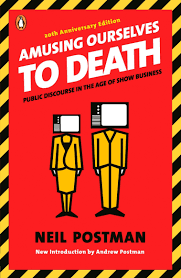
Amusing Ourselves to Death - by Neil Postman, 1985
Main Theme
The book and its author argues that technological shifs and changes in medium/means of communication have huge consequences on public discourse. Speficially, compared to print based media, television dumbed down the public discourse, and is focused on entertainment primarily, instead of transmitting actionable information. The author has no problem with television's junk, which threatens no one, but considers television the most dangerous when it aims high, when it presents itfself as a carrier of important cultural conversation.
The book was written 40 years ago, yet many of the observations stood the test of time and many of the predicted negative consequences got even worse with internet and short-form video platforms.
Also, as a personal note, it was quite challenging to read this book - compared to other, more recent non-fiction books which I've read. Most probably a good demonstration of the "dumbing down" effect, which can be observed even in written text.
Previous technological shifts
Introduction of a technology, technique transforms the thinking and the content of culture.
- Writing probably appeared magical to purely oral people at first. A conversion with no one, yet everyone. The author addressing an unseen audience. The silence when asking a question about the text.
- The invention of the clock, although we don't naturally think of it, caused a quite significant mental shift. Clocsk create the idea of moment to moment, it shifts natural time to an independent, precise mathematical sequence. In a way, it caused the authority of nature to be superseded, an irreverence (disrespect) towars the sun and seasons - as time is now made up os seconds, minutes, hours.
- Until 1840 information could only move as fast as human beings could carry it - as fast as trains, about 50km/hour. Space was a constraint on the movement of information. There was no continent wide conversation possible, each region was conversing in its own way.
- Then came the telegraph, putting electricity in the service of communication, eliminating space problem, collapsing regions and creating the possibility of unified discourse. But telegraph creates its own discource, it not only permits, but insists upon communication between two connected cities (even if there is nothing of importance to communicate). It gives a form of legitimacy to the idea of context-free information, the idea that the value of information is not tied to any function it might serve in social, policical decisions making and action - but is tied to its novelty, interest, curiosity.
- Almost at the same time photography was invented ("writing with light"). The naming is ironic, as imagery is totally different form writing - photography only only speaks in particularities - cannot deal with unseen, remote, internal, abstract. Picture are recognized, words are understood. "The graphic revolution" - imagery did not just suplement language, but did replace it as our dominant means for constructing, understanding, testing reality. Seeing, not reading, became the basis for believing.
- television gave the biases of telegraph and photography their most prominent expression, raising the interplay of instancy and imagery to perfeciton and brought it into the homes. All subjects find their way to television, and public understanding of these subjects is shaped by the biases of television.
The bias of the medium
Meida affects our epistemology, specifically our definitions of truth. The bias of the medium sits heavy over culture.
The forms of human communication influence which ideas can be expressed conviniently, and which in turn become important content of a culture
- Smoke signals can only transmit, basic, crucial information - does not allow for doing philosophy
- Oral cultures, tribes, settle disputes using cultural proverbs, which fit the situation
- In our society laws are written material, however testimony is expected to be given orally - spoken word is a "truer" reflection of the state of mind
- When writing a thesis references can only be given to other written text and not to the spoken word - compared to the spoken word, which is considered casually uttered, the published, written word has greater prestige, we assume to have been reflected upon, revised by its author and reviewd by editors or other parties.
- In our current day (1985) for example there is a bias in expressing truths with numbers. For example an economist cannot recite a poem, tell a personal anecdote to express truths about economic relationships as it would be considered irrelevant or childish. Of course this does not mean that all ways of truth telling are equal.
The concept of truth is intimately linked to the biases of forms of expression - the truth must appear in its proper clothing to be acknowledged, "truth" is kind of a cultural prejudice.
- trial of Socrates, he did not use rhetoric in his defense, apologized for not having a well prepared speech. Greeks were used to communicating truth through rigorous rhetoric, and thus may have dismissed Socrates' defense on the basis of the different form of expression.
- Hernan Diaz - the issue of truth, assumptions and pregiven notions that have to do with genre, place, voice
- label on a medicie box, persciption bottle - fully trusted, life might depend on it
- diary - unfiltered, truest thoughts, trusted
- newspaper - you don't trust it that much
Interesting religions examples
- second commendment of israelites - "You shall not make any graven image". God instructs people on how they were to symbolize or not symbolize their experience. A strange instruction to inclide in an ethical system, unless its author assumes connection between forms of human communication and the quality of the culture.
- the Amish believe any physical representation of themselves (whether a photograph, a painting, or film) promotes individualism and vanity, taking away from the values of community and humility by which they govern their lives (also based on the Second Commandment, which prohibits the making of "graven images")
The fiction of the news of the day
Newspapers were already publishing "human interest news" - crime and sex - which did not shape decisions or actions of the readers. But at least usually it was local, tied to places, people within their experience.
- But thanks to telegraph and photography, these human interest news could travel to all parts of the country. The fiction of the "news of the day" was born - usefulness, meaning, relevance all took a backseat. The abundant flow of information had very little to do with those to whom it was addressed - not related to their social, intellectual context
- Decontextualized infomration. The telegraphs promise, make "one neighborhood of the whole country", but this particular neighborhood was populated with strangers who only knew the most superficial facts about each other.
- Ask the question: how often it occures that information on the radio/TV/newspapaer alters your plans for the day, or make you take some action you did not plan, or provide insight into some problem you were trying to solve? Maybe the weather? Maybe the stock market if you are actively investing? But most of it just gives us topics to talk about, without leading to meaningful action. The legacy of the telegraph is a decreased information to action ratio.
With technology the relationship between information and action becomes both abstract and remote. People are simultaneously face with information glut and also diminished social and political potency.
- Pre-telegraph people had a greated sense of control over the contingencies in their life. Higher information-action ratio
- Starting with the telegraph sense of potenct was lost, the whole world became the context for news, everything became everyone's business. We were sent information that answered no question we have asked and did not permit a reply
Moving information quickly vs explaining, analyizing, evaluating information.
- News became sensational, fragmented, impersonal. Discontinous, totally different headlines
- this changed the meaning of "knowing" something - it transformed to knowing about a fact, but did not imply understanding implications, background and connections. No time for historical perspectives. Intelligence shifts to knowing about a lots of things, but not knowing about them.
Technology turned the age old problem of information on its head
- people once sought information to manage the real context of their life
- now they had to invent context in which otherwise useless information can be put to use. crosswords, cocktail parties, radio quiz shows, television game shows.
- pseudo-context, a structure invented to give fragmented and irrelevant information some use - like a telegraph about about unknown places, people - perfectly complemented with a photograph - that gave a concrete reality to it. An apparent context for the "news of the day"
Orwell vs Huxley
- The Orwellian world view of autocratic leaders, censorship, restriction to information - did not come about in the USA (although there are autocratic countries where it did)
- However the USA is closer to a Huxleyan vision of constant entertainment and amusement and disintrest in information
News shows are entertainment, not to be taken seriously, weeping over it, not for refleciton, education, catharsis - ther are to be seen and forgotten
- "Now...this" - world view, you have thought long enough about the issue (5 seconds) time to move on - no context, no consequence - pure entertainment
- television news shows are surrealistic, the discourse abandons logic, reason, sequence and rules of contradiciton - like dadaism in literature, nihilism in philolosophy, vaudeville/variete in theater-- news packaged as entertainment gives the illusion that it informs viewers, however in reality it alters the meaning of "being informed", because it deprives from coherent, contextual understanding. - - During the Iranian Hostage Crisis, everyone had an opinion, but it was more about having a feeling. As very little percentage of the popluation knew about iranian religious belifes, political history (the shah, Ayatollah).
Age of Typograpgy vs Age of Television
As culture moves from orality to writing to printing to television - its ideas of truth move with it. There is a shift in the content and meaning of public discourse.
Differences in thinkning in a word-centric culture vs image-centric culture.
- Typography amplifies - the ability to think conceptually, deductively, sequeantially, values reason and order, abhorres contradiciton, tolerates a delayed response
- Television transforms culture into show business, visual simulation is a substitute for thought - it becomes a technological narcotic of the Huxleyan world
Advertisements - TV commercials
- introduce nonpropositional use of language - they use image, tunes and slogens. Advertising became one part depth psychology and one part aesthetic (reason took a backseat)
- tv commercial is not at all about the product (character of the product to be consumed), but about the consumer (the character of the consumer of the product). Images of athletese, macho fishing, elegant dinners, happy families - tell nothing about the producet, but eveything about the fears, fancie, dreams of those who might buy them
- What the advertiser needs to know is not what is right about the product, but what is wrong with the buyer. making consumer feel valueable, like psuedo-therapy
- the commercial always addresses the pshycological needs of the viewer - instant therapy, makes you believe that problems are solvable, and fast, through purchasing some product
Television transforms culture into show business
- The first fifteen presidents of the US would no have been recognized had they passed by the average citizen. Public figures (lawyers, scientists, preachers) were known largely by their written words - not their looks or oratory. Thinink about these men is to thing about what they wrote, judge their arguments.
- Current (1985) presidents Nixon is a former hollywood actor, ohter candidate is an astronaut, and a third a televion show host. A bold, fat man cannot be the president. Cosmetics, took the place of ideology in politcs. The shape of a mans body is irrelevant to the shape of his ideas when addressing the public in writing, or on radio, however it is quite relevant in television. Television discourse is conducted through imagery
What is television? What kind of conversations does it permit, what intellectual tendencies it encouragesm what culture it produces?
- television made entertainment itself the natural format for the representation of all experiences - entertainment is the supraideology of all discoure on television
- news shows are entertainment, not to be taken seriously, weeping over it, not for refleciton, education, catharsis - ther are to be seen and forgotten
- thinking does not play well on television, there is not much to see in it - it's not a performing art, what television demands
- the nature of the medium is to surpress the content of ideas, in order to accomodate visual interest, the values of show business.
- the 1984 debate only gave limited time (5 minutes) to candidate to address quesitions and 1 minute to rebuttal. in these circumstances complexity, logic, documentation are diminished - and the candidates are evaluated not based on their ideas, but instead style, looks, gaze, one-liners delivered.
Politics as show business
- the main goal is to please the crowd. The idea is not to pursue excellence, but to appear as if you are - advertising (selling of the president)
- contradicition require statements and events to be perceived as interrelated aspects of a continous and coherent context. But as the context dissappears, or is fragmented, contradicitons disappear
- rise of celebrity politicians and the fall of political parties
- tv makes it impossible to determine who is a better candidate, better negotiator, executor, knowledgable about internal affairs and foregin policy, economical system
- On tv politicians are just concerned with presenting the best "image" - charm, looks, celebrity, personal disclosure
- tv's huge influence on political discourse
- 2025 US president
The modern mindhas grown indifferent to history, because it is deemed irrelevant, useless
- we know everything of what happened in tha last 24 hours, but we know very little about what happened in the last sixty years
- with what television offers, we are never denied the opportunity to amuse ourselves